In the rapidly evolving landscape of digital marketing, artificial intelligence (AI) has emerged as a transformative force across various industries. This article delves into how AI marketing solutions are reshaping the automotive, beverage, restaurant, and construction sectors. Readers will gain insights into the specific strategies that leverage AI for enhanced lead generation, customer engagement, and operational efficiency. As businesses face increasing competition and changing consumer behaviors, understanding the role of AI in marketing becomes crucial. This guide will explore the impact of AI on these industries, highlighting effective strategies, case studies, and the unique offerings of MBC Group AI, a leader in AI-powered marketing solutions.
Key Takeaways
- AI marketing enhances lead generation and customer targeting across automotive, beverage, restaurant, and construction industries.
- Predictive analytics and personalized marketing improve conversion rates and customer engagement in the automotive sector.
- AI-driven customer segmentation and automated campaigns optimize beverage marketing effectiveness and sales growth.
- Restaurants benefit from AI-powered marketing automation through personalized recommendations and loyalty program management.
- Construction companies use AI for targeted advertising, project marketing, and improved client relationship management.
- Selecting industry-specific AI marketing platforms ensures tailored features and better integration with existing workflows.
- Common AI marketing challenges include data quality issues, integration difficulties, and skill gaps requiring strategic solutions.
- Ethical AI marketing practices involve responsible data handling, transparency, and avoiding biases to build consumer trust.
- Measuring AI marketing success relies on KPIs like lead conversion, engagement, ROI, and continuous performance monitoring.
How does AI transform digital marketing in the automotive industry?
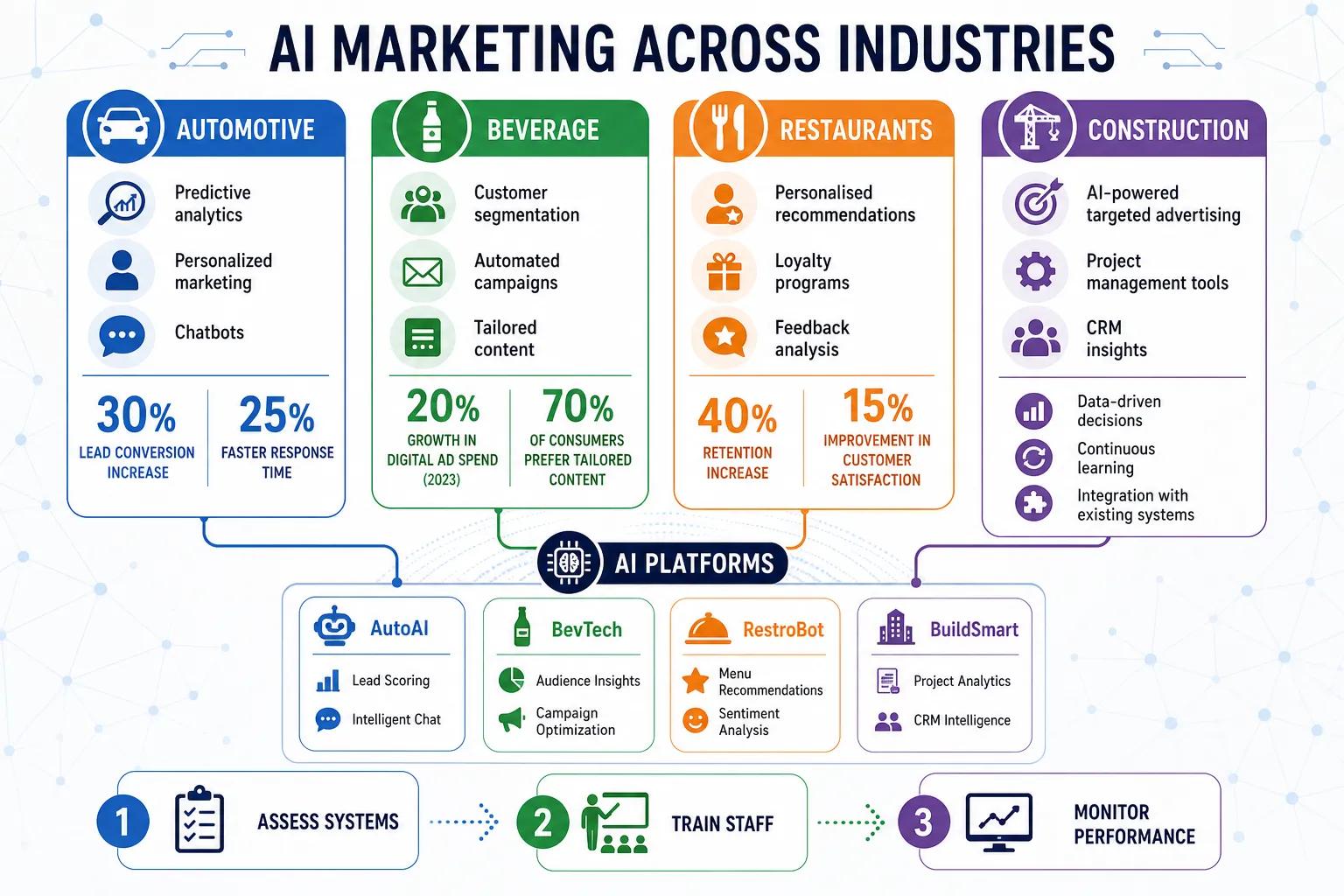
AI is revolutionizing digital marketing in the automotive industry by enhancing customer targeting and lead generation processes. Through advanced data analytics and machine learning algorithms, automotive marketers can identify potential customers more accurately and tailor their messaging accordingly. This targeted approach not only improves engagement rates but also increases the likelihood of conversion. By utilizing AI-driven insights, automotive companies can optimize their marketing strategies, ensuring they reach the right audience at the right time.
Key AI-driven strategies for automotive lead generation
Automotive lead generation has significantly benefited from AI technologies. Key strategies include:
- Predictive Analytics: AI analyzes historical data to predict future buying behaviors, allowing marketers to focus on high-potential leads.
- Personalized Marketing: Tailoring advertisements based on individual preferences and behaviors enhances customer engagement.
- Chatbots and Virtual Assistants: These tools provide instant responses to customer inquiries, improving user experience and capturing leads effectively.
These strategies demonstrate how AI can streamline the lead generation process, making it more efficient and effective.
Case studies showcasing AI success in automotive marketing
Several automotive companies have successfully implemented AI-driven marketing strategies. For instance, a leading car manufacturer utilized predictive analytics to identify potential buyers, resulting in a reported 30% increase in lead conversion rates. Another case involved a dealership that employed chatbots to handle customer inquiries, leading to a reported 25% reduction in response time and a significant boost in customer satisfaction. These examples highlight the tangible benefits of integrating AI into automotive marketing efforts.
AI in Automotive Marketing for Service Personalization
In todayʼs fast-paced world, where innovation and technology drive development, the automotive industry faces new challenges associated with high competition and ever-increasing customer expectations. Thepurpose of the articleis to analyze strategic approaches to the use of artificial intelligence (AI) in automotive marketing to personalize services and increase the competitiveness of enterprises.
Automotive business marketing with the use of artificial intelligence technologies for service personalization, V Ganchev, 2025
What are effective AI-powered marketing strategies for the beverage industry?
In the beverage industry, AI-powered marketing strategies are essential for understanding consumer preferences and optimizing marketing campaigns. By leveraging AI, companies can analyze vast amounts of data to identify trends and tailor their offerings accordingly. This approach not only enhances customer satisfaction but also drives sales growth.
Leveraging customer segmentation and automation in beverage marketing
Effective customer segmentation is crucial for beverage marketers. AI enables businesses to segment their audience based on various factors, such as purchasing behavior and demographics. This segmentation allows for:
- Targeted Promotions: Tailored offers can be sent to specific customer groups, increasing the likelihood of purchase.
- Automated Campaigns: AI-driven automation tools streamline marketing efforts, ensuring timely and relevant communication with consumers.
- Enhanced Customer Insights: Continuous data analysis provides deeper insights into consumer preferences, enabling more effective marketing strategies.
These strategies illustrate how AI can enhance marketing effectiveness in the beverage sector.
Recent trends and statistics in beverage digital advertising
Recent studies indicate a significant shift towards digital advertising in the beverage industry. In 2023, digital ad spending in this sector is expected to increase by 20%, reflecting the growing importance of online marketing channels. Additionally, consumer behavior trends show a preference for personalized marketing experiences, with 70% of consumers more likely to engage with brands that offer tailored content. These statistics underscore the necessity for beverage companies to adopt AI-driven marketing strategies to remain competitive.
How can restaurants benefit from marketing automation using AI?
Restaurants can greatly benefit from marketing automation powered by AI, which streamlines customer engagement and enhances operational efficiency. By automating marketing processes, restaurants can focus on delivering exceptional dining experiences while effectively reaching their target audience.
Implementing AI tools for restaurant customer engagement
AI tools can significantly improve customer engagement in the restaurant industry. Key implementations include:
- Personalized Recommendations: AI analyzes customer preferences to suggest menu items, enhancing the dining experience.
- Loyalty Programs: Automated loyalty programs reward repeat customers, fostering brand loyalty.
- Feedback Analysis: AI tools can analyze customer feedback to identify areas for improvement, ensuring a better overall experience.
These tools not only enhance customer satisfaction but also drive repeat business.
Success stories of restaurant marketing automation adoption
Numerous restaurants have successfully adopted AI-driven marketing automation. For example, a popular chain implemented an AI-based loyalty program that reportedly increased customer retention by 40%. Another restaurant utilized AI to analyze customer feedback, leading to menu adjustments that improved customer satisfaction scores by 15%. These success stories highlight the effectiveness of AI in transforming restaurant marketing strategies.
AI and Robotics for Competitiveness in Restaurant Business
Доведено, що впровадження робототехніки та штучного інтелекту є ключовим чинником підвищення конкурентоспроможності закладів у сучасних умовах.Мета дослідженняполягає в теоретичному обґрунтуванні рекомендацій щодо підвищення ефективності впровадження роботізації процесів обслуговування та виробництва в закладах ресторанного господарства.
Implementation of Robotisation and Application of Artificial Intelligence in the Hotel and Restaurant Business, 2024
What digital marketing solutions does AI offer for the construction industry?
The construction industry is increasingly leveraging AI to enhance marketing efforts and improve client acquisition. By utilizing AI-driven solutions, construction companies can streamline their marketing processes and better connect with potential clients.
AI applications for project marketing and client acquisition
AI applications in construction marketing include:
- Targeted Advertising: AI algorithms analyze market data to identify potential clients, allowing for more effective advertising strategies.
- Project Management Tools: AI-driven tools help manage marketing campaigns, ensuring timely delivery and effective communication.
- Client Relationship Management: AI enhances CRM systems by providing insights into client preferences and behaviors, improving engagement.
These applications demonstrate how AI can optimize marketing efforts in the construction sector.
Best practices for AI-driven construction marketing campaigns
To maximize the effectiveness of AI-driven marketing campaigns, construction companies should consider the following best practices:
- Data-Driven Decision Making: Utilize data analytics to inform marketing strategies and improve targeting.
- Continuous Learning: Implement machine learning algorithms that adapt to changing market conditions and consumer preferences.
- Integration with Existing Systems: Ensure AI tools seamlessly integrate with current marketing and project management systems for optimal efficiency.
By following these best practices, construction companies can enhance their marketing effectiveness and achieve better results.

Which AI marketing platforms best serve industry-specific needs?
Selecting the right AI marketing platform is crucial for businesses in the automotive, beverage, restaurant, and construction industries. Each sector has unique needs that require tailored solutions.
Comparing AI marketing tools for automotive, beverage, restaurant, and construction sectors
Different AI marketing tools offer distinct features suited for various industries. Here’s a comparison of some leading platforms:
| Platform | Industry Focus | Key Features | Benefits |
|---|---|---|---|
| AutoAI | Automotive | Predictive analytics, lead scoring | Improved lead conversion |
| BevTech | Beverage | Customer segmentation, automated campaigns | Enhanced targeting and engagement |
| RestroBot | Restaurants | Chatbots, loyalty programs | Increased customer retention |
| BuildSmart | Construction | Project management, CRM integration | Streamlined client acquisition |
This comparison highlights how different platforms cater to the specific needs of each industry, enabling businesses to choose the most suitable solution.
Integrating AI platforms with industry marketing workflows
Integrating AI platforms into existing marketing workflows is essential for maximizing their effectiveness. Key steps include:
- Assessing Current Systems: Evaluate existing marketing tools to identify integration points.
- Training Staff: Ensure team members are trained to use AI tools effectively.
- Monitoring Performance: Continuously track the performance of AI-driven campaigns to make necessary adjustments.
By following these steps, businesses can successfully integrate AI into their marketing workflows, enhancing overall efficiency.
What are common challenges and FAQs about AI marketing in these industries?
Despite the numerous benefits of AI marketing, businesses often face challenges in implementation and execution. Understanding these challenges is crucial for successful adoption.
Addressing implementation hurdles in AI-powered marketing
Common challenges in implementing AI marketing solutions include:
- Data Quality: Poor data quality can hinder the effectiveness of AI algorithms.
- Integration Issues: Difficulty in integrating AI tools with existing systems can lead to inefficiencies.
- Skill Gaps: A lack of expertise in AI technologies can impede successful implementation.
Addressing these challenges requires a strategic approach, including investing in data management and staff training.
Frequently Asked Questions
What are the key benefits of using AI in marketing across different industries?
AI in marketing offers numerous benefits, including enhanced customer targeting, improved lead generation, and increased operational efficiency. By analyzing vast amounts of data, AI can identify consumer trends and preferences, allowing businesses to tailor their marketing strategies effectively. This leads to higher engagement rates and conversion rates. Additionally, AI tools can automate repetitive tasks, freeing up time for marketers to focus on creative strategies. Overall, AI helps businesses stay competitive in rapidly changing markets by providing actionable insights and optimizing marketing efforts.
How can small businesses leverage AI marketing solutions?
Small businesses can leverage AI marketing solutions by utilizing affordable tools that offer features like customer segmentation, personalized marketing, and automated campaigns. Many AI platforms are designed to be user-friendly and cost-effective, making them accessible for smaller enterprises. By implementing AI-driven strategies, small businesses can enhance their marketing efforts without the need for extensive resources. For instance, using chatbots for customer service can improve response times and customer satisfaction, while predictive analytics can help identify high-potential leads, maximizing marketing ROI.
What role does data quality play in AI marketing effectiveness?
Data quality is crucial for the effectiveness of AI marketing. High-quality, accurate data ensures that AI algorithms can make reliable predictions and insights. Poor data quality can lead to incorrect targeting, ineffective campaigns, and wasted resources. Businesses should prioritize data management practices, including regular data cleaning and validation, to maintain the integrity of their datasets. By ensuring that the data fed into AI systems is accurate and relevant, companies can significantly enhance the performance of their marketing strategies and achieve better results.
Are there any ethical considerations when using AI in marketing?
Yes, there are several ethical considerations when using AI in marketing. Businesses must ensure that they handle consumer data responsibly, adhering to privacy regulations and obtaining consent for data collection. Transparency in how AI algorithms make decisions is also important to build trust with consumers. Additionally, marketers should be cautious of potential biases in AI systems that could lead to unfair targeting or exclusion of certain demographics. By prioritizing ethical practices, companies can foster positive relationships with their customers while leveraging AI technology.
How can businesses measure the success of their AI marketing initiatives?
Businesses can measure the success of their AI marketing initiatives through various key performance indicators (KPIs). Common metrics include lead conversion rates, customer engagement levels, and return on investment (ROI). Tracking these metrics over time allows companies to assess the effectiveness of their AI-driven strategies. Additionally, businesses can use A/B testing to compare the performance of AI-enhanced campaigns against traditional methods. Regularly analyzing these results helps organizations refine their marketing approaches and optimize their use of AI technologies for better outcomes.
What future trends can we expect in AI marketing across industries?
Future trends in AI marketing are likely to include increased personalization, enhanced predictive analytics, and the integration of AI with other emerging technologies like augmented reality (AR) and virtual reality (VR). As AI continues to evolve, marketers will be able to create even more tailored experiences for consumers, leveraging real-time data to anticipate needs and preferences. Additionally, the use of AI in content creation and customer service is expected to grow, enabling businesses to engage with their audiences more effectively and efficiently. Staying ahead of these trends will be essential for competitive advantage.
Conclusion
AI marketing solutions are revolutionizing industries like automotive, beverage, restaurants, and construction by enhancing customer engagement and operational efficiency. By leveraging data-driven insights, businesses can tailor their marketing strategies to meet specific consumer needs, ultimately driving growth and competitiveness. Embracing these innovative technologies is essential for staying ahead in today's fast-paced market. Discover how our AI marketing solutions can transform your business today.